
Learn how much different types of roofs cost and how contractors come up with their prices. Research costs to install asphalt shingles, flat and metal roofs.
- You have gotten 4 roofing quotes – which one do you choose?
- How come one contractor wants to charge you $7000, while another one gives you an estimate of $4000? Does the second one work for free, or the first one just wants to make extra $3K off of you?
- What goes into the cost of roof installation and how do contractors calculate their roof prices?
- Are you better off paying a premium to have a reputable roofing contractor working on your home, or going with the lowest bidder?
|
Low End
$4837
Mid Range
$6046
High End
$7558
|
|
|
 See costs in your area
These and many others are the questions any homeowner asks when it comes time to replace a roof – especially if it is leaking and you need to do it fast to prevent further damages. Here, we will discuss how contractors come up with their prices, and briefly describe how our online roofing calculator works, since it was designed to simulate a “virtual roofing contractor”, giving you an accurate roof replacement estimate.
This guide will also describe different roofing materials, as well as give an average cost per square to install each type. Additionally, we will briefly explain the “roof difficulty” concept and describe why a complicated two or three story roof costs 2-3 times more than a simple ranch-house roof.
Note: Asphalt Shingle prices have gone up in 2011 by about 25-30%, and we have updated our roofing materials calculator to reflect this price increase, and to provide you with a better cost estimate.
Read our full review of why roofing prices are going up, and what you can expect in the near future.
How Contractors Calculate Roofing Prices
First and foremost, there are two distinctly different methods of calculating the cost of roof installation. This is also true in other construction trades, such as siding, carpentry, etc.
Method one: Price per square (1 square = 100 sq. ft.)
Per Square pricing is the most popular (common) and the most fair method of estimating roofing prices, for both the homeowner and the contractor.
Personally, I always use Per Square pricing, unless the roof is really small or it is all cut-up and consists mainly of detail work. When I price a roof, my “first” concern is not really to make an “X” amount of money, but not to lose money on the given job, due to unforeseen complications and extra work. Therefore, first I try to anticipate and include everything that will be done during installation, and second – if I know there will be an unknown amount of extra work, I always exclude it from the total and price it when we actually know what we are dealing with. Additionally, I would up-charge a roof if I know there will be extra work, but I have no way of knowing how much, until we for example remove the old roof. In some cases, I leave it as a separate item, subject to change, depending on how much extra work will have to be done.
Method two: Materials, Labor, Overhead and Profit (MLOP).
This method deals with the cost of all components of the job: cost of Materials, cost of Labor, Overhead and Profit (MLOP). This is a better method for a large contractor, but may have flaws for both contractors and customers.
The main area where mistakes can be made is the cost of labor – which is actually unknown, and is estimated based on previous experience of the contractor. If the job is easy, this labor cost estimate will be more or less accurate. If a roof is complicated, there is a good chance the the contractor will make a mistake estimating labor costs, and you may be overcharged upfront or the contractor will tell you in the middle of the job that he miscalculated the labor and there must be a change order. In reality, unless you are dealing with a VERY experienced roof estimator and the company really knows its costs of labor and overheads, MLOP is not the preferred method of roof pricing.
Which Roof Pricing Method Is More Common?
While some roofers have different ways of calculating costs, most will actually use the Price Per Square method, as for most contractors, roofs have become a commodity, and installation is streamlined. Only complicated projects or specialty installation, using premium materials will include some type of combination of the above calculating methods. Examples of such complicated or specialty projects include most Copper / Zinc installations, multi-story historical and/or really cut-up colonial homes with towers, valleys, dormers, etc.
Cost of Roof Repair:
Roof repair is completely different from new installation or re-roofing. When you are getting a quote for repair work (https://www.roofingcalculator.org/roof-repair.php), you need to consider that very little materials are used to fix your roof. You are mostly paying for the labor itself and often the set-up costs. A contractor needs to get up on the roof, find the source of a leak and repair it. This is often done in one visit, and repair calls are not “too” profitable, compared to new installations. Also, you should not expect to get quotes for roof repair – most roofers won’t even waste their time to drive to your place and get up on the roof, only to lose a potential $300 job.
When we repair flat roofs in the Metro Boston area, we charge a $375 flat fee for materials and 2 hours of work. Some roofers do it differently, but most will have some sort of a flat fee for repair, and any additional work will be extra. Also note that 99% of the time, roof repairs are not guaranteed, which is more or less an industry standard. I’ve yet to find contractors that warranty their repair work.
The cost for a decent roof repair should be between $250 and $400 or more, depending on the scope of work, ease of access to the roof, and total time spent.
Roof Prices
Below we will list average roof pricing, which our roofing calculator is based on. These prices are generic and can only be used for reference purposes, as your actual quote will differ depending on your geographic location, and the contractor you choose to hire. For example, if your contractor is fully licensed and insured, and hires legal workers, your cost will be significantly higher than if you hired an uninsured roofer, who may be using illegal labor.
Asphalt Shingles Prices
Asphalt shingles is the most common residential roofing material in US. Due to lower material prices (as compared to metal, cedar shakes or tile roofs) and high competition, it is also the least expensive material.
Based on our experience and survey of contractors from different regions of continental US, the average price per square of Asphalt Shingles is in the range of $250-300. This price is to install a new 30-year dimensional (architectural) shingles on a walkable (3-6 roof pitch) ranch-type house. This price includes a tear-off + disposal of 1 layer of existing shingles, 15 lb. felt underlayment, new pipe flashing for plumbing vents (stink-pipes) and ridge cap, using either special ridge-cap shingles or color-matching three-tab shingles.
Chimney re-flashing, Ice & Water shield, ridge vent, rotten wood replacement, sky-light flashing, etc. are usually extra, and most contractors charge for them “per item” or per linear foot, as is the case with ridge vent and Ice & Water shield.
The average cost to flash a chimney is $300, and should include new counter-flashing. Skylight flashing is about $200.
A ridge vent is $5-7 per linear foot. Ice & Water shield is $4-6+ per linear foot, depending on the type / brand of Ice & Water product used. Smooth-faced Grace I&W shield is the most expensive type and is rarely used, while a granular surface I&W shield is the least expensive and most common.
Ice & Water barrier is required by building code in most areas with significant snow falls – northern US and Canada – while it is optional in most of southern US. If your building code does not require use of I&W barrier, I would recommend not using it as it prevents the roof deck from “breathing”, consequently shortening the life of your roof deck.
The average cost-per-square for an asphalt shingle roof will vary greatly based on where you live. The same roof in Metro Boston, MA will cost almost double one located somewhere in rural Alabama or in the now-struggling metro Detroit area. The average cost of a roofing square in Massachusetts ranges from $375 – $425 per square. Basically, roofing costs are directly related to the cost of living in your area.
Metal Roofing Prices:
Metal is an excellent choice to solve your roofing problems for a VERY long time, and most metal roofs are considered life-time material. They offer long-lasting protection, reduction in energy costs (as most are in fact cool roofs, and qualify for $1500 federal tax credit). When properly installed, metal roofs eliminate / solve most leak issues such as Ice Dams. However, metal roofs cost significantly more than conventional asphalt shingles.
Since there are many types of metal roofs, from a multitude of manufacturers, I will concentrate on the three most common types: Standing Seam, Exposed Fasteners Metal Panels (corrugated steel, R-panel, V5-crimp, etc.) and Interlocking Metal Shingles.
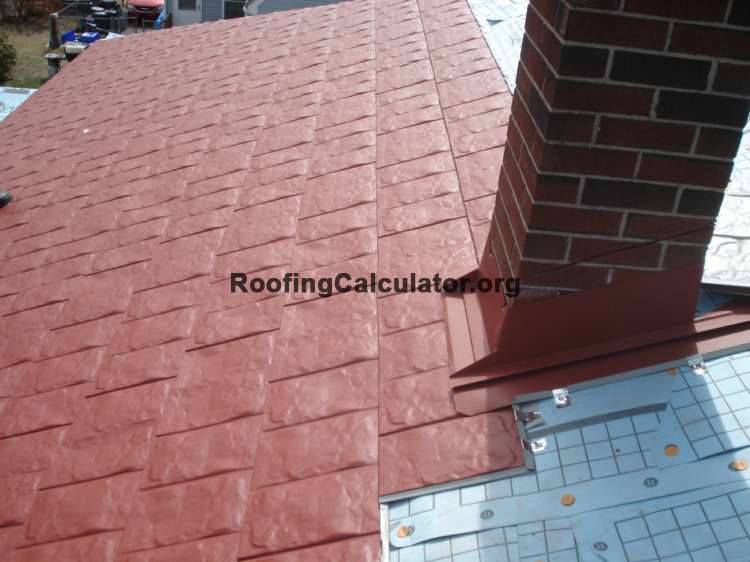
As is the case with asphalt shingles, our average metal roof prices are based upon a walkable, ranch-type house with 1 layer of roof tear-off and disposal and normal penetration flashing. However, in case of metal roofing, things like Ice & Water and ridge vent installation, are included in the price. Other things that should be included are: Snow Guards in the northern US / Canada, synthetic underlayment (if your contractor proposes to use Felt / tar-paper with a metal roof, kick them out of the house and tell them to never call you again). A complete chimney re-flashing, using color-matching flashing and counter-flashing, as well as custom-fabricated skylight flashing must be installed, though it can be charged for separately.
Cost of Standing Seam
While a standing seam roof may seem easy to install, it is only the case on roofs, such as straight gable with a minimal number of penetrations. As the roof gets more complicated, installation of Standing Seam becomes MUCH more complicated, as compared to interlocking shingles. For example, a non-walkable (9-12 roof pitch) hip-roof is VERY difficult to nearly impossible to install, without the use of a hydraulic platform lift, as the installer has nowhere to hook his hook-latter, and it is also impossible to install roof jacks without penetrating roof panels. Therefore, a relatively difficult roof will cost dramatically more to install standing seam on, vs. metal shingles.
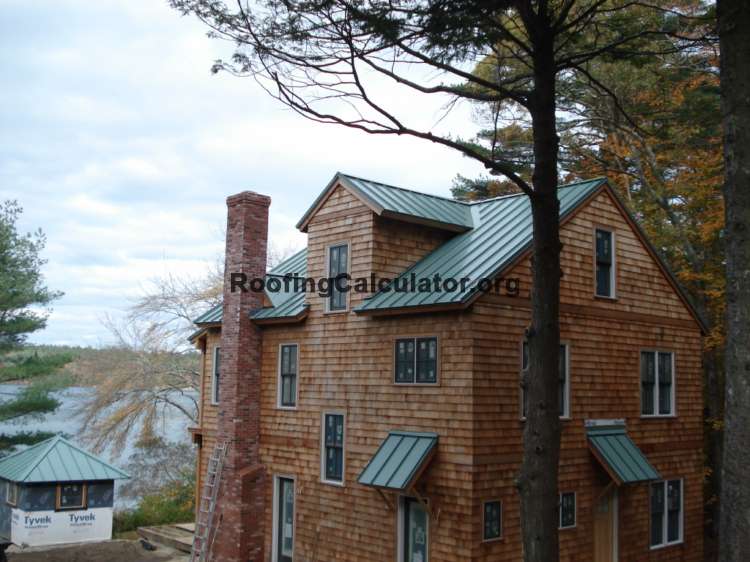
The cost to install the metal roof in a picture above, was about $1300 per square.
Cost of Steel Standing Seam ranges from $800-1000 for a simple gable roof.
As soon as the roof becomes more complicated, the price goes up to $1200-1500 range. Aluminum standing seam will add about $75-100 per square to account for additional materials cost of aluminum vs. steel. Sky-light and chimney flashing on a standing seam roof will cost an average of $400 per unit, vs. $300 per unit on a metal shingles roof, as they are much more involved and complicated.
Please note that unlike metal shingles, standing seam panels should not be installed over asphalt shingles, as the shingles profile will punch through the vertical panels, creating horizontal lines every 5 inches – this is a so called telegraphing effect of metal roofing.
Cost of Metal Shingles
Metal roofing shingles will cost a little less to install on a simple roof, as compared to standing seam. On a complicated roof, metal shingles will be significantly CHEAPER to install, as compared to standing seam. This is because metal shingles’ design allows to install roof-jacks (roof staging), and installers can easily move around the roof, without using a lift. It is also much easier to install and remove fall-protection / safety harnesses equipment on a metal shingles roof.
Cost to install steel shingles, on a simple gable roof: $775-850 per square.
Cost to install aluminum shingles, on a simple gable roof: $875-950 per square.
A more complicated roof will increase in price by $100-200 per square (compared to an increase of $350-500 in case of a standing seam roof).
Cost of Exposed fasteners / Corrugated Steel
Exposed fastener steel panels is the least expensive option in the world of metal roofing, but is also the worst one in terms of quality. This type of material is usually made of cheap 29 ga. steel, coated with cheap acrylic paint (compared to a minimum of 26 ga. steel and Kynar 500 metal roof coating for steel standing seam, and .032″ aluminum + Kynar 500 for alum. standing seam roofs). The difference will start to show itself in about 10 years, as the paint may / will begin to fade, peel and chip off the metal, and first signs of rust stains will begin to appear.An exposed fastener roof will also have to be “re-fastened” around the 10-year mark, as rubber / neoprene washers will dry out, and water will start seeping in.
The cost of exposed fastener metal panels ranges at $500-700 per square for a simple gable roof.
Exposed fastener metal panels SHOULD NOT be installed on complicated roofs or within 1 mile from the salt – water shoreline. As for complicated roofs, exposed fastener metal panels lack proper flashing details, and re-fastening them after 10 years will be very costly and dangerous.
As far as the salt-water environment, any steel roof should not be installed within 1 mile of the coast as corrosion will eat such a roof in a very short period of time. Aluminum is the best choice for a metal roof to be installed near the water.
Additional Up-Charges For More Difficult Roofs
Contractors will generally charge more for the following items or in the following situations:
- Second or third story roof
- More than one layer of roof tear-off / disposal
- Tearing off cedar shingles, slate or tile on sloped roofs and tar+gravel / bur roofing materials on a flat roof.
- Difficult customer – the so called PITA up-charge (Pain In The A$$).
- Difficult roof access
- Small roof / complicated roof
- Steep roof
Pricing Guides for Niche Roofing Materials
Part 2 – Metal Roofing Prices
Part 3 – Flat Roof Prices
|
Low End
$4837
Mid Range
$6046
High End
$7558
|
|
|
i would like to get this for someone i know but need to know does it work in ontario this person deals with roofmart will the apt be caculated in ontario price and for roofmart if not i think it would be good to find out besides lowes for price not city nor province not country has a lowes
Handsplit and resawn cedar comes in two different grades and many
different thicknesses. A roofing estimate should also account
for the fact that these installations include starter
strips, which eliminates waste. If you are going to pay for the repairs or replacement cost
out of your own pocket you are going to have to take your budget into consideration.
Leo,
I am not sure if my email went out. Can you email me so I can talk to you about your app. I just purchased it, however I have some questions. I would like to know how to change the markup and the labor per man. I am from Alaska how do you change pricing for materials?
Thanks Jesse
Thank you for this very helpful and informative site.
Any roofer in Phila , pa
need to install a roof 26*20 falt roof
Hi Sam,
You can get free roofing estimate here: Cool Flat Roof – they specialize in flat roofing and have IB Roof certified contractors in PA.
Good morning,
I got a price from a contractor that i trust to replace my roof for $7500 in central ca. It was a double tear off, asphalt shingles on top of cedar shingles. I bought the materials for $2300 to cover 18 square (his measurements). I upgraded the OSB to radiant barrier, for minimal cost. I noticed at one point that there was enough OSB for my house but not my garage. The contractor tells me that his employee calculated wrong and i need to buy an additional $1300 in materials. Also at one point one of his guys put his foot through the ceiling in my bathroom. His idea is for me to purchase a fan to put in the hole. Do i just buy the materials and shut up or negotiate some sort of trade off i.e. reduction in profit for him?
what about tiles like monier , s tiles , low profilt s tile
Hi Lance
Honestly I don’t know much about tiles, since they are not very popular (to say the least) in the North Eastern US – all I know is that tiles are EXPENSIVE and HEAVY and require special framing.
If you want to submit an article about tiles – we now have Roofing Article / guest blog post submission page – just write a “Tile Roof Prices” article and I will post it, as well as mention your roofing company / website.
Leo.
Hello-
Looking to install a metal shingle roof on a cottage on the St Lawrence (NY- Clayton). The existing roof is cedar shake, it is 40 years old, no leaks that I know of, the house is post beam type; there is some kind of insulation layer under the shakes. Easily walkable 3-6 pitch. 3 penetrations- 1 plumbing vent, 1 sky light, 1 triple wall chimney. About 1000square feet. No dormers.
Do you know anyone out my way who does this type of installation?
Very usefull information delivered in an easy to understand real world way. Thank you for this effort. I am seriously considering an aluminum shingle roof on my split level 40 miles north of Boston. With cathedral ceilings inside will I hear rain’s pitter-patter? What are the drawbacks other than initial cost?
Hello George,
Honestly, metal shingles roof is my favorite type of metal roofing materials, and I’ll be installing it on my house this spring – already purchased all the materials and am now waiting for good weather when my guys get a few days off. I went with still shingles thought, because of difference in cost and because we live far from the ocean and installing aluminum is not necessary. If you want to know that your roof will NEVER rust, than aluminum is the way to go, but I am very confident that still will last me 50+ years based on my experience of installing it. I have some scrap pieces of flashing and shingles laying in my back bone yard, with cut edges exposed to weather all year round for many years now with not a single spot of rust on them.
Since you live in Massachusetts, if you are looking to install aluminum or steel shingles roof, we can do it for you – send me an email ( leo @ newenglandmetalroof.com ) or fill out our online estimate form here: http://www.newenglandmetalroof.com/free-roofing-estimate.html and we will discuss the details and pricing.
One thing I want to mention is that the pricing here is generic and represents a national average based on my experience and research, and in MA it might be slightly more. It will all actually depend on your roof details and scope of work, but we will work with you to give you best pricing.
PS, I emailed you a copy of my response.
Versico does in fact certify contractors for workmanship warranties, you are incorrect.
Versico is a private label for Carlisle and contractors who install Versico, are usually those who were rejected certification by Carlisle.
Versico provides warranty for commercial project – not residential.
Also, you either forget to mention or drop this on purpose – when a rubber roof leaks, any manufacturer will go out of their way to decline warranty claim. They will find ponding water issues, foot traffic, bad installs, etc.
Also, they ONLY warranty material – not seams. In case the warranty is NDL (no dollar limit) labor warranty, where they do inspect the job and typically issue a 10-15 years warranty, it costs you about $0.10 per sq. ft. to buy that warranty, with I believe a 100 squares minimum ($1000 for the warranty), and you also must use all of their materials and accessories, etc. This means that many clients will opt out of the warranty and will be waiting until the roof leaks.
nice for comparative purposes.
better if included spray foam and coating–although I realize there are many combinations of coatings and foam type and thickness.
Hi Jim,
We don’t install Spray Foam Roofing, so i am not very familiar with the cost of SPF roofs. We did bid against a contractor who installs SPF, and they came in at about $600 per square for 2″ foam with a coating – I’m not sure if it was acrylic or urethane. Also the job had many curbs and also a T-Mobile antenna on the roof which had to be removed.
SPF is not too popular in the north east and there are very few roofing contractors installing it around here. In fact this company we bid against was from Florida. Most flat roofing jobs around here are rubber roofs, and some PVC and TPO roofing.
If you have some information about SPF roofing prices which you can share with us, it would be most helpful.
Pingback: Roofing Materials Calculator
Pingback: Roofing Materials and Prices Calculator Update.
Pingback: Metal Roofing Prices – find out how much a metal roof costs.
Pingback: Nothing found for How-to-measure-roof Php
Pingback: Roof pitch - how to measure and calculate roof slope
Pingback: Get roofing calculator for your website
Pingback: Roofing calculator features update
per sq pricing is not an accurate way of pricing that is called ball parking very seldom do we measure 2 roofs that have the same attributes every roof is unique in its own way depending on how the roof faces the sun how much shade from trees or lack of them
dormers valleys skylights every roof needs a different amt of ice and water shield or ridgevents
the material cost can be way different from roof to roof as well as the labor cost too not know your exact material and labor cost before starting is very dangerous just my opinion dont want customers to be mislead.
the differences are usually people not properly doing the job or the are not insured properly with liability & workerscomp for roofing or they are a fly by night guy working out of their truck good luck catching them if you roof fails. hire someone with an actual place of business things to consider
Pingback: Cool Roof Tax Credit Scam